
The January 2025 Mandate: Why Every Building Owner Needs a Plan Now
New York City’s ambitious energy-saving goals are driven by various Local Laws, but Local Law 88 of 2009 (LL88) stands out because it requires physical upgrades rather than just reporting. With the final compliance deadline of January 1, 2025, fast approaching, building owners must finalize and execute their projects to avoid steep annual fines.
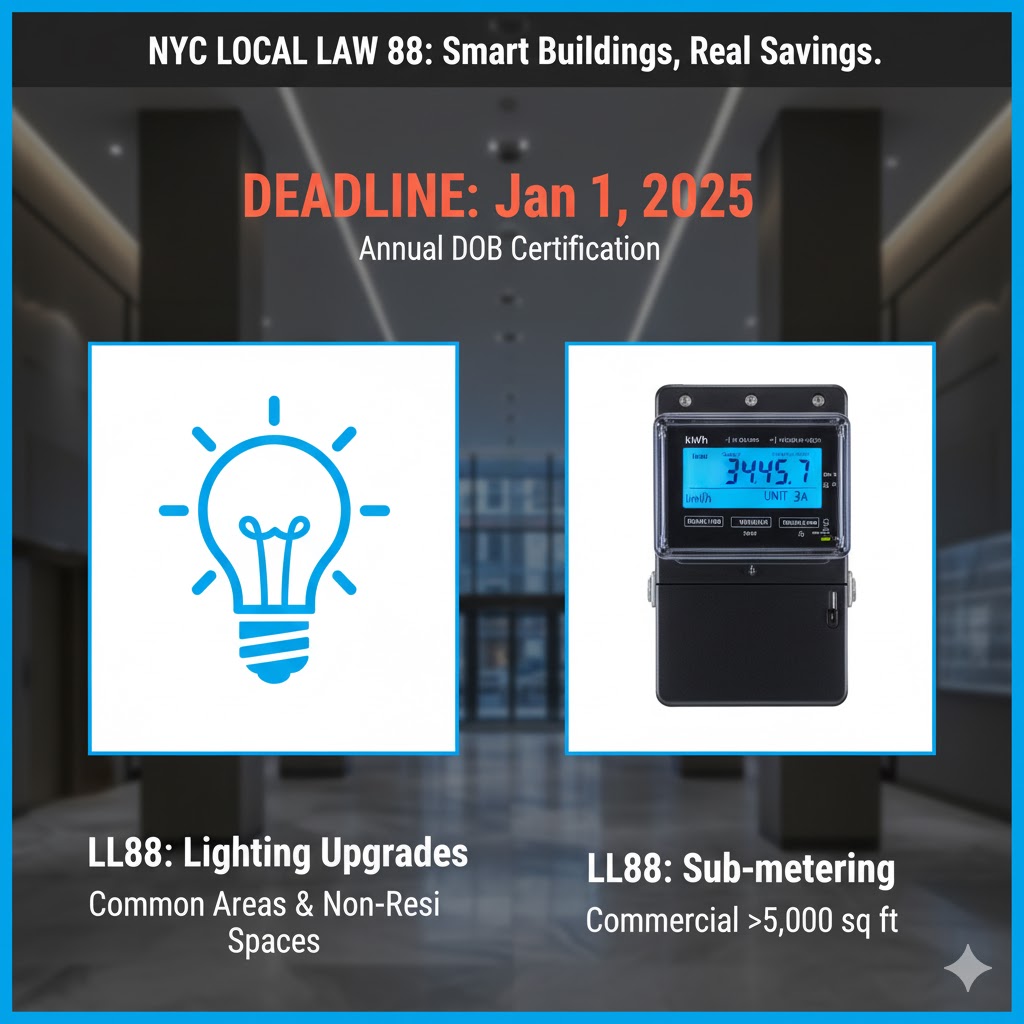
LL88 focuses on two major areas: energy-efficient lighting upgrades and commercial tenant sub-metering.
Who is a “Covered Building”?
LL88 applies to a large segment of NYC real estate, including both commercial and residential properties.
Your building is generally considered “covered” if it meets any of the following criteria:
- Buildings over 25,000 gross square feet.
- Two or more buildings on the same tax lot that together exceed 100,000 gross square feet.
- Two or more buildings under the same condominium management that together exceed 100,000 gross square feet.
If your property is on the NYC DOB Covered Buildings List, you must comply.
Requirement One: Lighting Upgrades
The law mandates that lighting systems in covered buildings must be upgraded to meet the standards of the New York City Energy Conservation Code (NYCECC).
| Area of Impact | Required Action |
| Common Areas | All lighting in lobbies, hallways, stairwells, basements, mechanical rooms, and service areas must be upgraded. |
| Non-Residential Spaces | All lighting in commercial, retail, or amenity areas must be upgraded. |
| Technology | Upgrades typically involve installing high-efficiency LED lighting, as well as automatic shutoff switches, occupancy sensors, and other lighting controls. |
| Exemptions | Individual dwelling units (R-2 and R-3 occupancy) are exempt from the lighting upgrade requirement. |
Note on Previous Upgrades: If your lighting system was installed after July 1, 2010, and was compliant with the NYCECC in effect at that time, it may be deemed compliant, but certification is still required.
Requirement Two: Electrical Sub-metering
The second core requirement focuses on increasing energy accountability by measuring the electrical consumption of certain non-residential spaces.
- Sub-meters must be installed to measure the electrical consumption of each covered tenant space.
- Covered Tenant Spaces include:
- Any tenant space larger than 5,000 gross square feet on one or more floors, rented to the same person.
- Any floor larger than 5,000 gross square feet consisting of tenant spaces rented to two or more different persons.
- Reporting: After January 1, 2025, owners must provide monthly statements to these tenants detailing their electrical consumption as measured by the sub-meter.
The Compliance Deadline and Penalties
Ignoring the LL88 mandate carries significant, accumulating financial risk.
- Installation Deadline: January 1, 2025
- Reporting Deadline: May 1, 2025 (The report, certified by a Registered Design Professional or Licensed Electrician, must be filed with the DOB.)
Annual Penalties for Non-Compliance:
| Violation | Annual Fine |
| Failure to file Lighting Compliance Report | $1,500 per BIN |
| Failure to file Sub-metering Compliance Report | $1,500 per BIN |
| Failure to install required Sub-meters | An additional $500 per covered tenant space |
These fines are assessed annually until compliance is fully met.
Partner with Ethos PM to Meet the Deadline
LL88 compliance is not just an electrical project; it’s a project management challenge involving coordination with tenants, licensed professionals, and the DOB.
Ethos PM Group ensures a seamless, cost-effective transition to compliance by:
- Comprehensive Audits: Working with engineers to quickly identify all areas requiring upgrade or sub-meter installation.
- Strategic Bidding: Managing the RFP process for electrical contractors and ensuring competitive bids on all lighting and sub-metering installations.
- Tenant Coordination: Minimizing disruption by carefully phasing work in common areas and working around tenant operating hours.
- Documentation & Filing: Securing the necessary permits, overseeing the final certified report submission to the DOB, and ensuring all documentation is audit-ready.
 Ethos PM Group
Leave a comment