
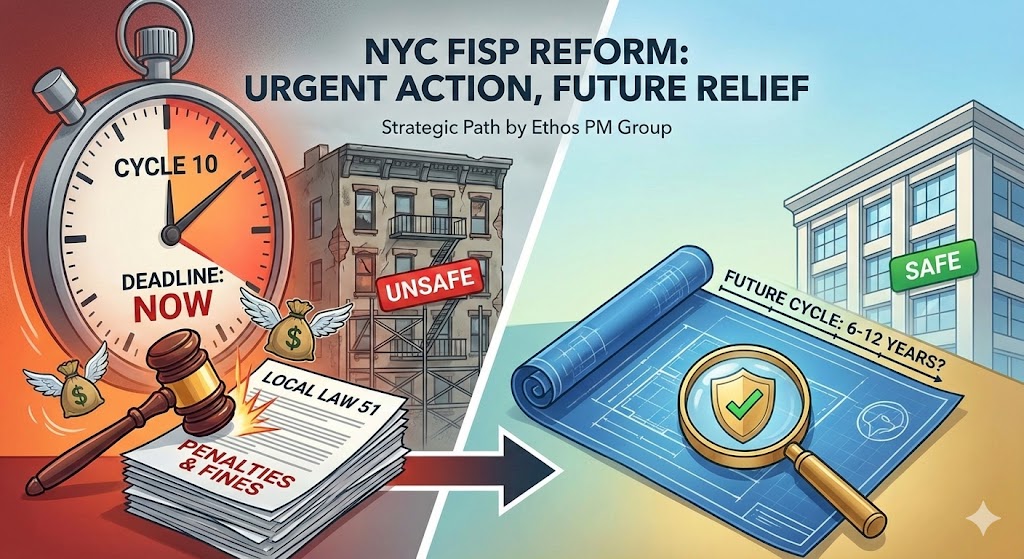
For years, New York City’s Facade Inspection and Safety Program (FISP), or Local Law 11, has operated on a rigid five-year cycle. Now, change is in the air. Recent legislation—specifically Local Law 49 of 2025—is directing the DOB to study extending the inspection cycle to anywhere from 6 to 12 years.
This news sounds like a massive relief. However, as experts guiding mandatory construction projects, we need to caution against complacency. This reform comes with a major, immediate catch: The City is doubling down on punishing procrastination.
Here is the strategic breakdown of why this news makes approving your current FISP Cycle 10 project more urgent than ever.
The Business Risk: Penalties Now, Relief Later (Maybe)
In business, you manage the risks you know. The greatest risk right now is betting against the current DOB deadlines.
| Analogy: The City’s Negotiation | The FISP Project Decision |
| The Deal: “We might give you a longer repayment term down the road, but if you miss this month’s payment, the fine is 500% higher.” | The Mandate: “You must comply with Cycle 10 (2025-2029) now, or face immediate fines. Delaying required repairs will result in crippling new penalties.” |
The Immediate Financial Threat:
- Cycle 10 is Live and Unchanged: Your building must still file within its specific Cycle 10 window. Missing it triggers a $1,000 per month late filing penalty—a guaranteed, compounding cost.
- The LL 51 Enforcement Hammer: Local Law 51 of 2025 (part of the same package as LL 49) introduces astronomical new penalties for delay. If you secure a shed permit for mandated repairs and fail to complete the work within two years, you face fines ranging from $5,000 to $20,000 for just that specific failure. These are punitive measures designed to force action.
- Controlling the Repair Cost: A delayed repair means a minor SWARMP condition turns into a major UNSAFE one. This requires emergency intervention (costly consultants, expedited contractors) and instantly puts your building into a costly, chaotic, and reactive state.
The Strategic Value: Earning the Right to a Longer Cycle
The proposed reform is a clear reward system: the City wants to give competent, compliant owners more flexibility, but it wants to severely penalize irresponsible ones. By executing your Cycle 10 project now, you are strategically positioning your building as a responsible owner worthy of the future 6-to-12-year cycle.
- Securing the New Standard: A completed, safe, and certified Cycle 10 report is your ticket to being eligible for the maximum extension the DOB may eventually allow (up to 12 years). This translates to substantial long-term savings on future FISP inspection costs and repair cycles.
- Budgeting Peace of Mind: Completing the work now means you lock in current material and labor rates and can proactively plan the next major capital reserve contribution years down the line. You move your budget from the “crisis” column to the “strategic investment” column.
- First Mover Advantage: By acting early in your filing window, you secure the best QEWIs (Qualified Exterior Wall Inspectors) and the highest quality, most vetted contractors before the inevitable rush toward the end of the cycle.
Your Clear, Reassuring Path Forward
The uncertainty of reform combined with the fear of fines can create paralysis among boards. Our role at Ethos PM Group is to remove that anxiety by taking command of the process.
We simplify the FISP project into three command-and-control steps:
- Immediate Assessment & Filing: We partner with your QEWI to execute the inspection, secure the report, and manage the filing before the late penalties kick in.
- Expedited Repair Management: If repairs are required, we focus on aggressively managing the construction timeline. We oversee the bidding, secure the permits, and hold the contractor accountable to ensure the work is completed well within the two-year LL 51 penalty window.
- Future-Proofing: We ensure all required documentation is in place for six years (including annual parapet observations) and position your building perfectly to benefit from any future cycle extensions adopted by the DOB.
Don’t wait for future relief to be finalized—act on the current mandates today to protect your building’s finances and earn the right to greater flexibility tomorrow.
 Ethos PM Group
Leave a comment